How to Tell If a Recession Is Coming: 5 Key Indicators to Watch
Recessions don’t happen randomly. They are usually preceded by a combination of economic signals—rising interest rates, tightening credit, weakening demand, and shifts in financial markets.
While no single indicator is perfect, a small set of leading signals has historically provided strong warnings ahead of most recessions.
In this article, we look at five of the most reliable indicators and what they tell us about the economy.
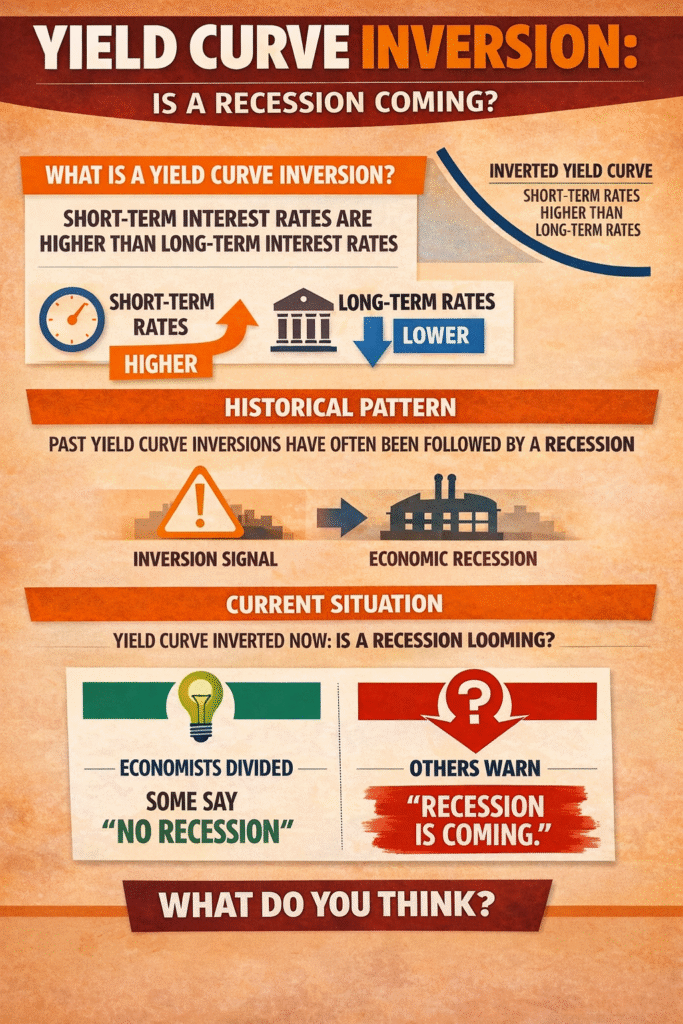
1. The Yield Curve (The Most Reliable Signal)
The yield curve measures the difference between short-term and long-term interest rates.
Normally:
- long-term rates > short-term rates
But when the curve inverts (short-term > long-term), it signals that markets expect:
- slower growth
- lower future interest rates
Historically, yield curve inversions have preceded almost every U.S. recession in recent decades.
Why it works:
- Central banks raise short-term rates to fight inflation
- This tightens financial conditions
- Growth slows → recession risk rises
👉 Key takeaway:
An inverted yield curve is one of the strongest early warning signs.
2. Interest Rates and Monetary Tightening
Recessions are often the result of central banks tightening too much.
When interest rates rise:
- borrowing becomes more expensive
- investment slows
- consumption weakens
This is especially important after periods of:
- high inflation
- aggressive rate hikes
Higher oil prices → inflation → central banks raise rates → growth slows
Click here to learn more about Oil Price Spikes
👉 Key takeaway:
Recessions are often caused by tightening financial conditions.
3. Credit Conditions (Where Problems Usually Start)
Credit is the lifeblood of the economy.
When banks and lenders:
- tighten lending standards
- reduce risk exposure
it becomes harder for businesses and consumers to borrow.
This leads to:
- lower investment
- reduced spending
- rising defaults
This is also where newer risks—like private credit markets—can become important.
👉 Key takeaway:
Recessions often begin when credit starts to contract.
4. The Labor Market (Lagging but Important)
Employment is usually strong until late in the cycle.
Typical pattern:
- economy slows
- hiring freezes
- layoffs increase
Rising unemployment confirms that:
- the slowdown is spreading
- demand is weakening
👉 Important nuance:
The labor market is a lagging indicator, not an early one.
5. Leading Economic Indicators (Early Signals of Weakness)
Several forward-looking indicators can signal trouble ahead:
- Manufacturing PMIs (business activity)
- Consumer confidence
- New orders and industrial production
When these start declining:
- it suggests future economic activity will weaken
👉 Key takeaway:
These indicators help confirm early-stage slowdowns.
What History Tells Us
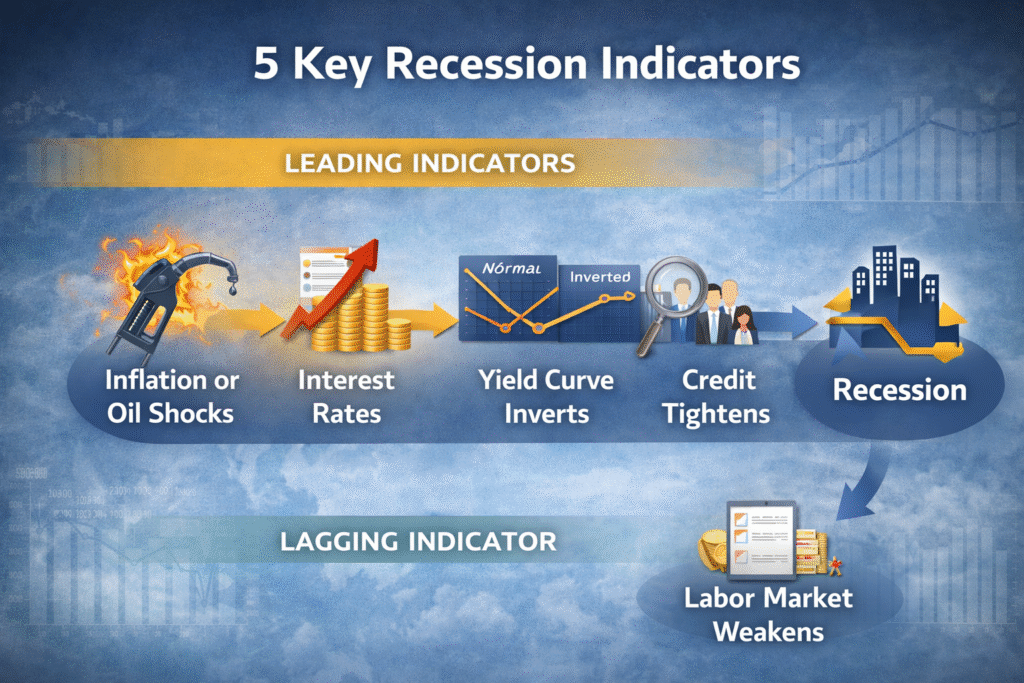
Looking across past cycles, recessions tend to follow a similar pattern:
- Inflation rises (often driven by shocks like oil)
- Central banks raise interest rates
- Financial conditions tighten
- Credit slows
- Growth weakens → recession
This sequence has repeated across multiple cycles.
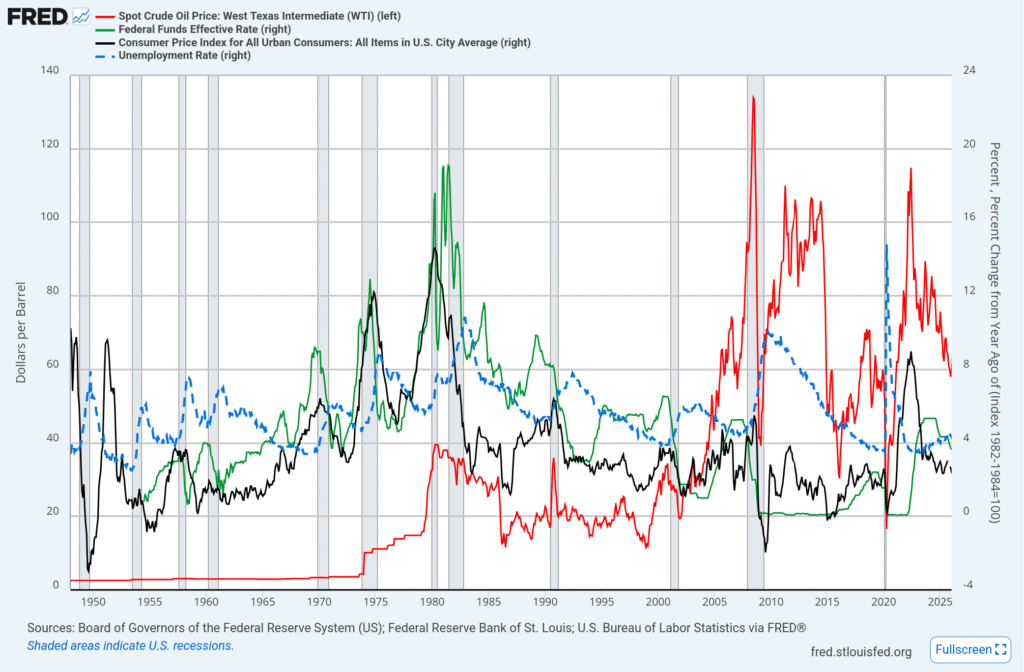
We have created a set of charts dating back to the 1950s, containing the oil price, the consumer price index (CPI), Federal funds rate and the unemployment rate.
Although each market cycle is different in terms of the exact timing and catalyst that pushes markets into a downturn, we can clearly observe:
- Oil (red line) is highly correlated with the consumer price index change year-over-year, that is, the annualized inflation rate (black line)
- The FED funds rate is rising or has been higher than in the previous years right before a recession period (1956,1969,1973,1981,1989,2000, 2007, 2019, 2026)
- The rise in FED funds rate has an overlap with the rise in inflation (1976-1980) or a delay of a few months relative to the beginning of an inflation increase (eg. 2004, 2022)
- The unemployment rate is usually low before a recessionary period and takes a few months into a recession to meaningful increase. The unemployment rate is a lagging indicator, thus, it is just a confirmation of the recession.
No Single Indicator Is Enough
One of the biggest mistakes investors make is relying on a single signal.
- The yield curve may invert early
- The labor market may still look strong
- Markets may send mixed signals
👉 The key is combination and timing
When multiple indicators align, recession risk rises significantly.
Final Thoughts
Recessions are not unpredictable shocks—they are usually the result of tightening financial conditions and slowing economic activity.
By tracking a small set of indicators—yield curve, interest rates, credit conditions, labor markets, and leading data—you can get a clearer picture of where the economy may be heading.
No indicator is perfect. But together, they provide a powerful framework for understanding the business cycle.
Subscribe below to be notified each time we publish new material!