Why Credit Conditions Matter: The Hidden Signals Behind Economic Stress
Economic downturns rarely begin with obvious signals like rising unemployment. Instead, stress tends to emerge quietly—within the financial system itself.
One of the most important but often overlooked areas is credit conditions.
These determine how easily households and businesses can access financing—and when they tighten, the economy often follows.
What Are Credit Conditions?
Credit conditions refer to:
- how easy it is to borrow
- how expensive borrowing is
- how much risk lenders are willing to take
They are influenced by:
- interest rates
- market sentiment
- bank balance sheets
- financial system stress
Key idea
“Credit conditions are where monetary policy meets the real economy.”
Why Credit Conditions Drive the Cycle
Even if central banks cut or raise rates, what matters is:
Do banks and markets actually lend?
When credit is:
- loose → growth accelerates
- tight → the economy slows
This is why credit often leads the business cycle.
Key Indicators to Track Credit Conditions
1. Financial Conditions Index (NFCI)
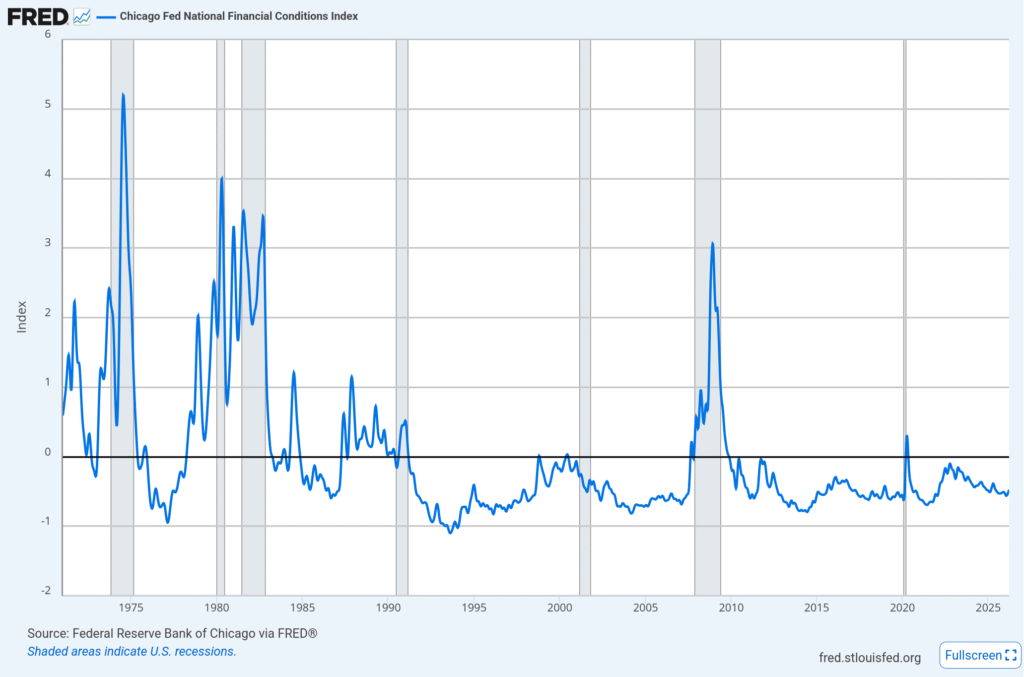
The Chicago Fed National Financial Conditions Index is one of the most comprehensive measures.
What it includes:
- interest rates
- credit spreads
- leverage
- market volatility
How to read it:
- Below 0 → loose financial conditions
- Above 0 → tight financial conditions
Why it matters:
It captures system-wide stress, not just one market.
2. Credit Spreads (High Yield vs Treasuries)
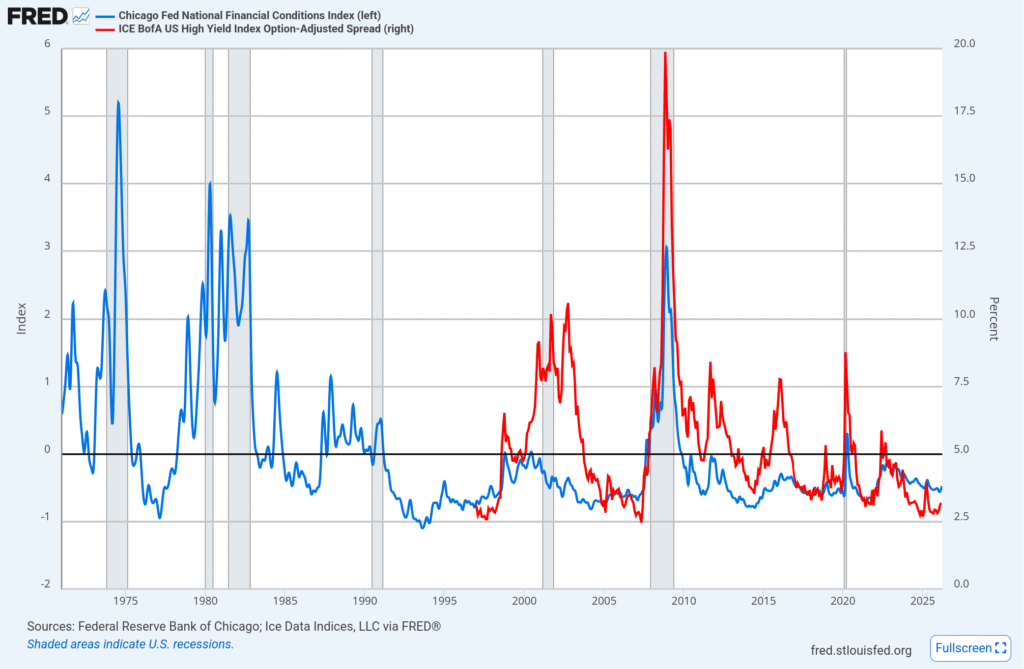
One of the most important real-time indicators is the spread between high-yield (junk) bonds and government bonds
This is often tracked using indexes like the ICE BofA US High Yield Index Option-Adjusted Spread.
What it shows:
- investor risk appetite
- perceived default risk
Typical behavior:
- Spreads narrow (low) → confidence, easy credit
- Spreads widen (high) → stress, tightening
During crises:
- spreads spike sharply (e.g. 2008, 2020)
3. Bank Lending Standards
Banks periodically report whether they are tightening or loosening lending standards.
A key source is:
- the Senior Loan Officer Opinion Survey
What to watch:
- % of banks tightening credit
Why it matters:
This is often an early signal of recession risk.
4. Real Interest Rates
Not just nominal rates—but inflation-adjusted rates.
When real rates are:
- rising → borrowing becomes more restrictive
- high → pressure builds on borrowers
This is especially important in:
- housing
- corporate debt
5. Liquidity & Market Functioning
In stressed environments:
- liquidity dries up
- bid-ask spreads widen
- markets become less efficient
Even small shocks can have outsized effects.
How Credit Tightening Leads to Recession
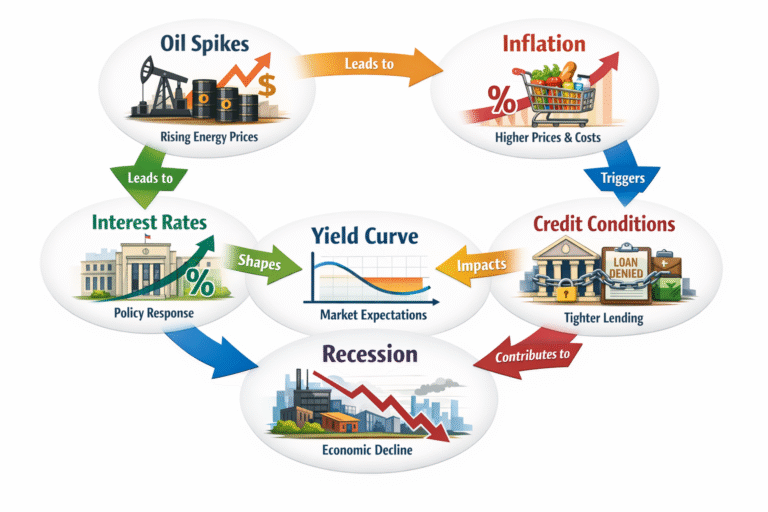
Here’s the mechanism:
- Interest rates rise
- Credit spreads widen
- Banks tighten lending
- Borrowing declines
- Investment and consumption fall
- Economy slows → recession
Strong takeaway
“Recessions don’t start when unemployment rises—they start when credit quietly stops flowing.”
Historical Examples
2008 Global Financial Crisis
- Credit spreads exploded
- Banks stopped lending
- Financial system stress triggered deep recession
2020 COVID Shock
- Spreads widened rapidly
- Liquidity evaporated
- Central banks intervened aggressively
2022–2024 Cycle
- Rising rates
- gradual tightening in credit
- stress emerging in parts of the system
Why Credit Is the Most Important Indicator
Compared to other indicators:
- Yield curve → expectations
- Labor market → lagging
- Inflation → noisy
Credit conditions:
- reflect real stress
- affect real activity
- move early
Final Thoughts
If you want to understand where the economy is heading, don’t just look at growth or inflation.
Look at: how easy it is to borrow. Because when credit tightens, everything else tends to follow.