Inflation is one of the most widely discussed economic concepts, yet it is often poorly understood. While it is commonly described as a general rise in prices, inflation is better understood as a process shaped by supply, demand, and the monetary system.
What Causes Inflation?
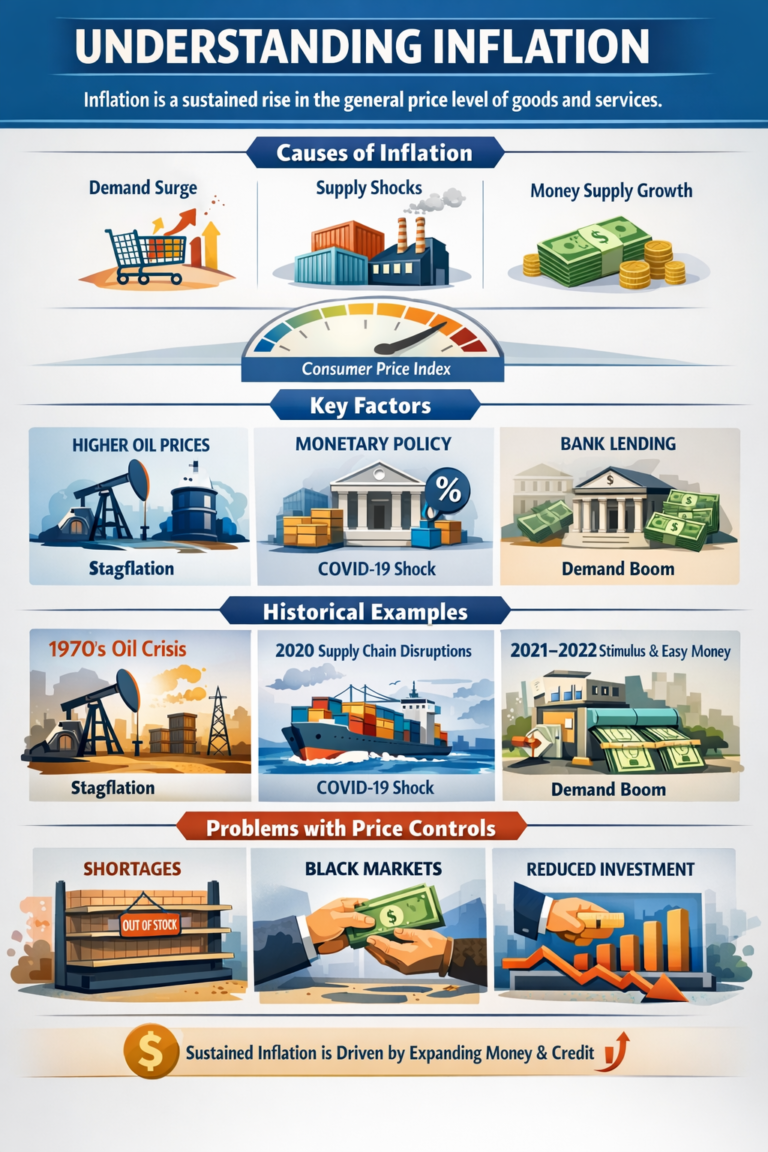
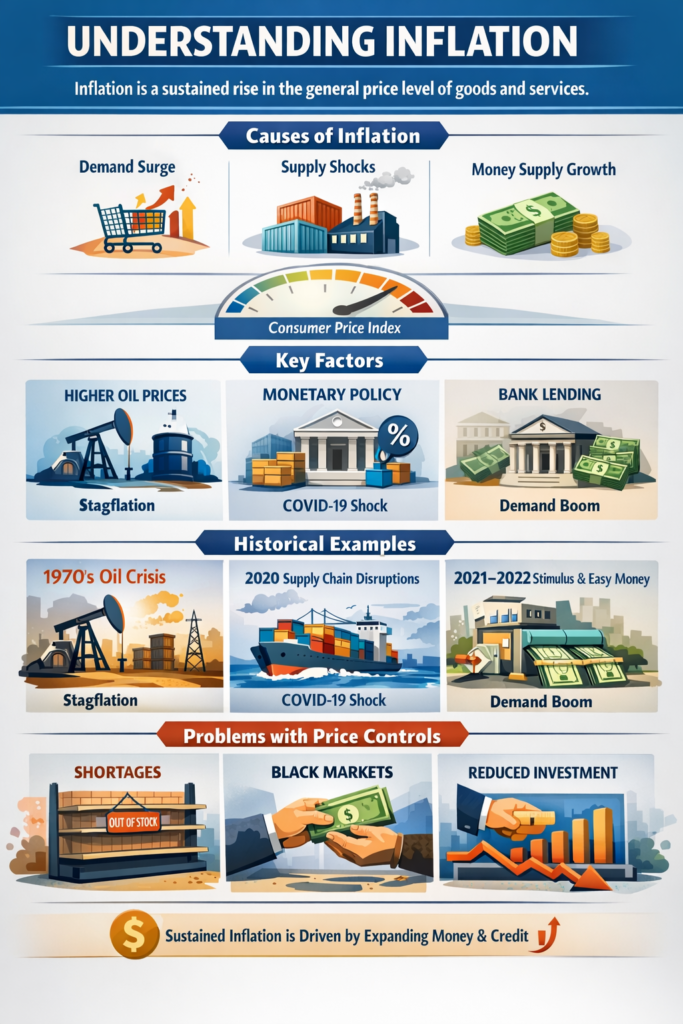
Inflation is caused by a sustained increase in the general price level, typically driven by a combination of strong demand, supply constraints, and expansion in the money supply and credit.
These forces often interact:
- demand increases push prices higher
- supply disruptions raise production costs
- monetary expansion allows price increases to persist
What Is Inflation?
Inflation refers to a sustained and broad-based increase in the prices of goods and services across an economy.
A key distinction is that:
- one-off price increases are not inflation
- inflation requires persistence and generalization
For example, a spike in oil prices may raise energy costs, but it becomes inflationary only when it spreads across the economy.
How Is Inflation Measured?
Inflation is most commonly measured using the Consumer Price Index (CPI), which tracks the average change in prices of a basket of goods and services over time.
CPI includes categories such as:
- housing
- food
- energy
- transportation
- healthcare
It is published regularly by statistical agencies and serves as the primary benchmark for inflation.
What Are the Limitations of CPI?
While widely used, CPI has important limitations.
First, it reflects an average consumer and may not capture individual experiences. Housing costs, in particular, vary significantly across regions.
Second, CPI incorporates substitution effects, meaning that when prices rise, consumers are assumed to switch to cheaper alternatives. This can understate the true cost of living.
Third, some components—especially housing—are measured indirectly, often smoothing real price movements.
Finally, CPI does not fully capture asset price inflation, such as housing or equities, which can be critical for financial stability.
Demand vs Supply Inflation
What is demand-driven inflation?
Demand-driven inflation occurs when aggregate demand exceeds the economy’s productive capacity.
It is typically associated with:
- strong economic growth
- fiscal or monetary stimulus
- rapid credit expansion
What is supply-driven inflation?
Supply-driven inflation occurs when production costs increase or supply is disrupted, leading to higher prices.
Common causes include:
- energy shocks
- supply chain disruptions
- geopolitical tensions
The Role of Oil in Inflation
Oil plays a central role in inflation dynamics because it is a key input across the economy.
Rising oil prices increase costs in:
- transportation
- manufacturing
- agriculture
These cost increases propagate through supply chains, contributing to broader inflationary pressure.
The Role of Monetary Policy and Banks
Persistent inflation requires monetary and credit expansion.
Central banks such as the Federal Reserve and the European Central Bank influence inflation through interest rates.
However, commercial banks are equally important because they:
- create money through lending
- determine how credit flows into the economy
Inflation is therefore closely linked to the credit cycle, not just policy rates.
Inflation and the Money Supply
Sustained inflation requires a persistent increase in the money supply or credit.
While individual prices can rise independently, a generalized increase in prices over time requires monetary accommodation.
This can occur through:
- central bank balance sheet expansion
- bank lending
- fiscal deficits
Without these, price increases tend to be temporary.
Historical Examples of Inflation
The 1970s in the United States
During the 1970s:
- oil shocks increased production costs
- monetary policy remained accommodative
- inflation expectations became entrenched
The result was prolonged high inflation, eventually brought under control through aggressive tightening.
2020: The COVID-19 Supply Shock
In 2020:
- global supply chains were disrupted
- production declined sharply
This created supply-driven inflation, particularly in goods markets.
2021–2022: Demand Surge and Monetary Expansion
Following the pandemic:
- fiscal stimulus boosted demand
- interest rates remained low
- credit expanded
This combination transformed temporary price increases into sustained inflation.
Are Wars Inflationary or Deflationary?
Wars can be either inflationary or deflationary depending on their economic effects.
They are inflationary when they:
- disrupt supply (especially commodities)
- increase government spending
They can be deflationary if they:
- reduce demand
- trigger economic contraction
This topic deserves a dedicated analysis in a future article.
Prices as Signals in the Economy
Prices play a fundamental role as signals.
Higher prices:
- encourage increased production
- attract investment
- reduce consumption
This process helps rebalance supply and demand over time.
Why Price Controls Often Fail
Price controls attempt to limit price increases but often lead to shortages, reduced supply, and market distortions.
1. United States – Wage and Price Controls (1971–1974)
Under President Richard Nixon, the U.S. imposed broad wage and price controls starting in 1971.
What was controlled:
- wages across industries
- consumer prices
- energy prices (notably gasoline)
What happened:
Inflation temporarily slowed, but underlying pressures remained.
Consequences:
- producers reduced supply due to capped prices
- gasoline shortages emerged
- long queues formed at fuel stations
- inflation surged again after controls were lifted
2. Venezuela – Price Controls (2000s–2010s)
Venezuela imposed strict price controls on essential goods during the 2000s and 2010s.
What was controlled:
- food staples
- household goods
- medicines
Consequences:
- domestic production collapsed
- imports declined
- severe shortages developed
- black markets emerged with much higher prices
3. Argentina – Price Freezes (2000s–2020s)
Argentina repeatedly implemented price controls and “fair price” programs.
What was controlled:
- food products
- consumer goods
Consequences:
- supply shifted to unregulated products
- product quality deteriorated
- inflation persisted elsewhere in the economy
Rent Control: A Modern Example of Price Controls
What is rent control?
Rent control limits how much landlords can charge or increase rents, aiming to improve housing affordability.
Berlin – Rent Freeze (2020–2021)
Berlin introduced a rent freeze in February 2020, capping rents at 2019 levels. The policy was overturned in April 2021 by the German Federal Constitutional Court.
Consequences:
- rental supply fell significantly (estimates: 25–50%)
- demand surged for regulated units
- prices increased in unregulated segments
- investment in housing declined
(Studies by DIW Berlin and ifo Institute)
San Francisco – Rent Control Expansion (1994)
San Francisco expanded rent control in 1994. A 2019 study by Stanford University economists found:
Consequences:
- rental supply declined (~15%)
- landlords converted units to condos
- overall rents increased citywide
New York City – Long-Term Regulation (1940s–present)
New York’s rent regulation system dates back to the 1940s.
Consequences:
- persistent housing shortages
- reduced mobility
- dual market structure:
- low rents for regulated tenants
- high rents for new entrants
(Reports from New York City Rent Guidelines Board and National Bureau of Economic Research)
Economic Mechanism of Price Controls
Across all cases:
- lower prices increase demand
- lower profitability reduces supply
- shortages and distortions emerge
Key Insight
“Price controls do not eliminate inflation—they redistribute it, often in more disruptive ways.”
Why the Monetary System Is Structurally Inflationary
Modern economies tend to exhibit an inflationary bias. This is not accidental, but rather the result of how the financial system is structured and the incentives embedded within it.
Three key forces help explain this tendency.
Managing High Levels of Public and Private Debt
One important factor is the large amount of debt in the system.
Governments, companies, and households all rely heavily on borrowing. Over time, this creates an incentive to allow moderate inflation, because inflation reduces the real value of debt.
In practical terms:
- Debt is fixed in nominal terms (e.g., €1,000 remains €1,000)
- But inflation reduces what that €1,000 is worth in real purchasing power
This makes existing debt easier to repay.
For governments, this is particularly important. Countries with high debt levels benefit from inflation because:
- tax revenues tend to rise with nominal economic activity
- the real burden of outstanding debt declines
Even relatively low inflation, sustained over time, can significantly erode debt burdens.
In this sense, inflation acts as a gradual and indirect mechanism for reducing debt.
Flexibility for Macroeconomic Stabilization
A second reason is that inflation provides policymakers with tools to respond to economic downturns.
Central banks such as the European Central Bank and the Federal Reserve influence the economy primarily through interest rates.
When inflation is positive, central banks can:
- lower interest rates during recessions
- stimulate borrowing and investment
- support economic activity
However, if inflation were zero or negative, this becomes much more difficult.
In a deflationary environment:
- interest rates quickly approach zero
- central banks lose their ability to stimulate demand
- real debt burdens increase
This dynamic has been observed in economies such as Japan during prolonged periods of low inflation.
For this reason, most central banks target a small but positive inflation rate (around 2%), which provides room to act during downturns.
Incentivizing Investment and Reducing Idle Capital
A third, often overlooked reason is that inflation discourages holding idle cash and encourages productive investment.
In a world with no inflation:
- holding cash preserves purchasing power
- there is less urgency to invest
In contrast, when inflation is positive:
- cash loses value over time
- investors are incentivized to seek returns
This pushes capital toward:
- business investment
- financial markets
- real assets
From a macroeconomic perspective, this is desirable because:
- investment supports economic growth
- capital is allocated more actively
- resources are not left idle
However, this dynamic can also have side effects:
- it may encourage excessive risk-taking
- it can contribute to asset price inflation
Inflation therefore acts as a mechanism that mobilizes capital, but not always efficiently.
Putting It Together
These three forces reinforce one another:
- inflation helps reduce existing debt burdens
- inflation gives policymakers room to stabilize the economy
- inflation encourages investment and capital allocation
Together, they create a system in which:
- money and credit tend to expand over time
- the general price level tends to rise gradually
Refined Takeaway
“Inflation is not just a side effect of the system—it is, to some extent, a feature that helps manage debt, stabilize the economy, and encourage investment.”
Final Thoughts
Inflation is not driven by a single cause but by the interaction of multiple forces.
It often begins with supply or demand shocks, but becomes persistent only when supported by monetary and credit expansion.
Understanding inflation requires looking beyond headline indicators and examining the deeper structure of the economic and financial system.